It’s a question worth asking.
If two wigs are both labelled “100% human hair,” and one costs $600 while another costs $6,000, what could possibly account for a tenfold difference in price?
From a photograph, the answer isn’t always obvious.
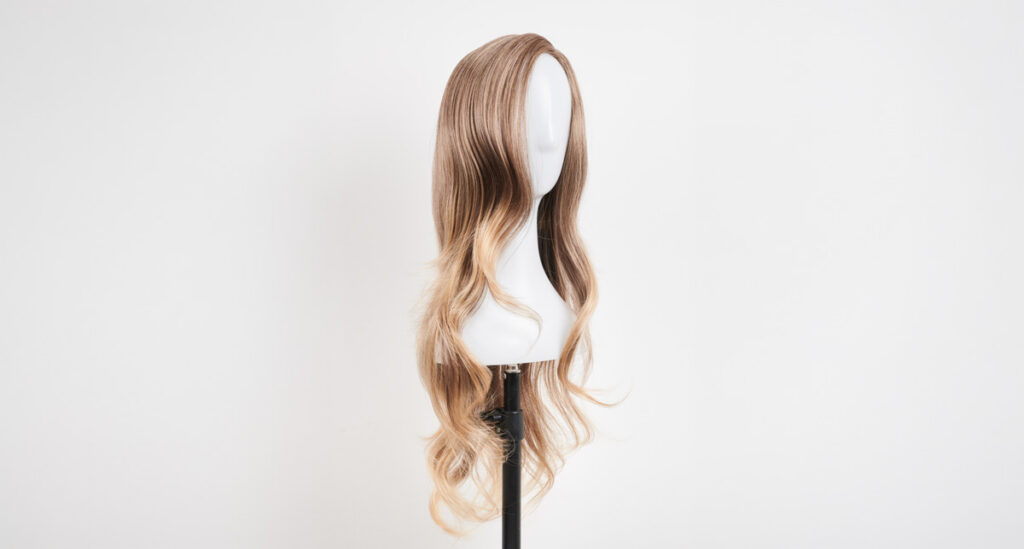
Both wigs may be long. Both may be beautifully styled. Both may have attractive colour. In fact, sitting on a mannequin or appearing in a carefully lit photograph, they may initially look surprisingly similar.
But wigs are one of those products where much of what you’re paying for isn’t immediately visible.
The difference is in the hair, the construction, the craftsmanship—and ultimately, what happens when the wig is actually worn.
“Human Hair” Doesn’t Tell You Very Much
One of the biggest misconceptions in the wig industry is that human hair is a single category of material.
It isn’t.
Human hair varies enormously in origin, texture, diameter, condition and the amount of chemical processing it has undergone.
Lower-priced human hair wigs are generally produced using hair that is readily available in very large quantities. The hair may also undergo significant chemical processing to create consistent colour and texture.
At the other end of the spectrum are exceptional Virgin European hair wigs, made from hair that has been carefully sourced and selected for its natural qualities.
Virgin hair has not been chemically coloured or processed. That matters because the integrity of the hair has been preserved.
Beautiful raw hair is expensive before anyone has even begun making the wig.
And that is only the beginning.
Great Hair Has to Be Sorted
When we receive beautiful hair, we don’t simply put it into a wig.
Hair has to be evaluated and sorted.
Colour matters. Texture matters. Length matters. The diameter and character of the hair matter.
Even within what appears to be one shade of brown or blonde, there can be extraordinary variation.
Natural hair isn’t a flat colour.
It contains subtle differences in tone that give it depth and movement.
Selecting and combining hair properly is part technical skill and part artistic judgment—and it takes time.
Construction Changes How a Wig Behaves
The inside of a wig may be even more important than the outside.
Mass-produced wigs are designed to fit a broad range of people. That makes sense: when something is being manufactured in volume, it has to work reasonably well for many different head shapes.
A custom wig is approached differently.
The shape and proportions of the cap can be created and adjusted for the individual wearer.
Where the hair is placed matters too.
The direction in which individual hairs are ventilated influences how the hair falls, where it wants to move and how naturally it behaves.
These are details you may never consciously notice.
But when they’re done well, you notice the result.
Handwork Is Expensive
This is perhaps the least understood part of the price of quality wigs.
A beautifully made wig requires human hands.
Skilled hands.
Individual hairs may be ventilated into delicate foundations by hand. Cap components are constructed and assembled. Hair is sorted, blended, coloured, cut and styled.
And the people doing this work don’t acquire those skills overnight.
Some techniques require years of experience before someone becomes truly proficient.
When you purchase something made largely by hand, you aren’t simply paying for the hours it took to make that particular piece.
You’re also paying for the years it took someone to learn how to make it beautifully.
Colour Is More Than Choosing a Shade
Creating believable colour is another area where craftsmanship becomes important.
Natural-looking hair colour usually isn’t one uniform shade from root to tip.
There may be dimension around the face, subtle variations through the lengths, slightly different tones at the root and carefully placed highlights or lowlights.
With exceptional European hair, we often want to preserve as much of the natural character of the hair as possible.
The goal isn’t necessarily to create perfectly uniform colour.
Quite often, those tiny variations are exactly what make the hair look real.
More Hair Doesn’t Mean a Better Wig
This surprises many women.
When you’re comparing wigs, it can be tempting to assume that more hair means greater value.
But believable hair isn’t about maximum density.
It’s about appropriate density.
Natural hair isn’t equally dense everywhere. A well-designed wig takes this into consideration, particularly around the hairline, temples and part.
Sometimes creating a more natural wig actually means using less hair—but putting that hair in exactly the right places.
Then the Wig Has to Meet the Woman
Even an extraordinarily well-made wig isn’t truly finished until we see it on the person who will wear it.
This is where fitting, hairline adjustments, density, parting, haircut and face framing become important.
A beautiful wig can still be wrong for a particular face.
The forehead, cheekbones, jawline, neck, shoulders and overall proportions of the wearer all affect how the hair should ultimately be shaped.
Sometimes we make significant changes.
Sometimes we make changes so small that another person might barely notice what we’ve done.
But suddenly the wig looks right.
That final customization is part of the product too.
What Happens Six Months Later?
Perhaps one of the best ways to judge a wig isn’t how it looks on the day you buy it.
It’s how it looks after you’ve lived in it.
Hair is washed. Styled. Brushed. Touched. Exposed to heat, humidity, clothing and everyday friction.
This is where differences in hair quality and construction can become much more apparent.
A wig is not something most of our clients wear for twenty minutes.
For many women experiencing hair loss, it becomes part of their everyday life.
Longevity, comfort, movement and the ability to maintain and repair the piece therefore matter enormously.
So Is a $600 Wig a Bad Wig?
Not necessarily.
There is a place for wigs at many different price points.
Not every woman wants or needs a bespoke wig made from exceptional European hair, just as not everyone needs handmade shoes or a tailored suit.
The important thing is understanding that these products aren’t interchangeable simply because the label on both says “human hair.”
The difference in price reflects differences in raw materials, sourcing, construction, skilled labour, customization and the amount of time that goes into creating the finished piece.
What You’re Really Paying For
When you look at a beautifully finished wig, you see hair.
What you don’t see are all the decisions and all the hands behind it.
Someone selected the hair.
Someone sorted it.
Someone constructed the foundation.
Someone ventilated it.
Someone created the colour.
Someone fitted it.
Someone cut it.
Someone stood back, looked at the woman wearing it and decided that one tiny section around her face still wasn’t quite right.
And then someone fixed it.
That is where much of the difference between a mass-produced wig and a truly exceptional wig lives.
Not in a label.
Not in a photograph.
And not simply in the fact that both are made from human hair.
It lives in the quality of the raw materials, the skill of the people making it and the thousands of small decisions that ultimately make beautiful hair look like it belongs to the woman wearing it.